
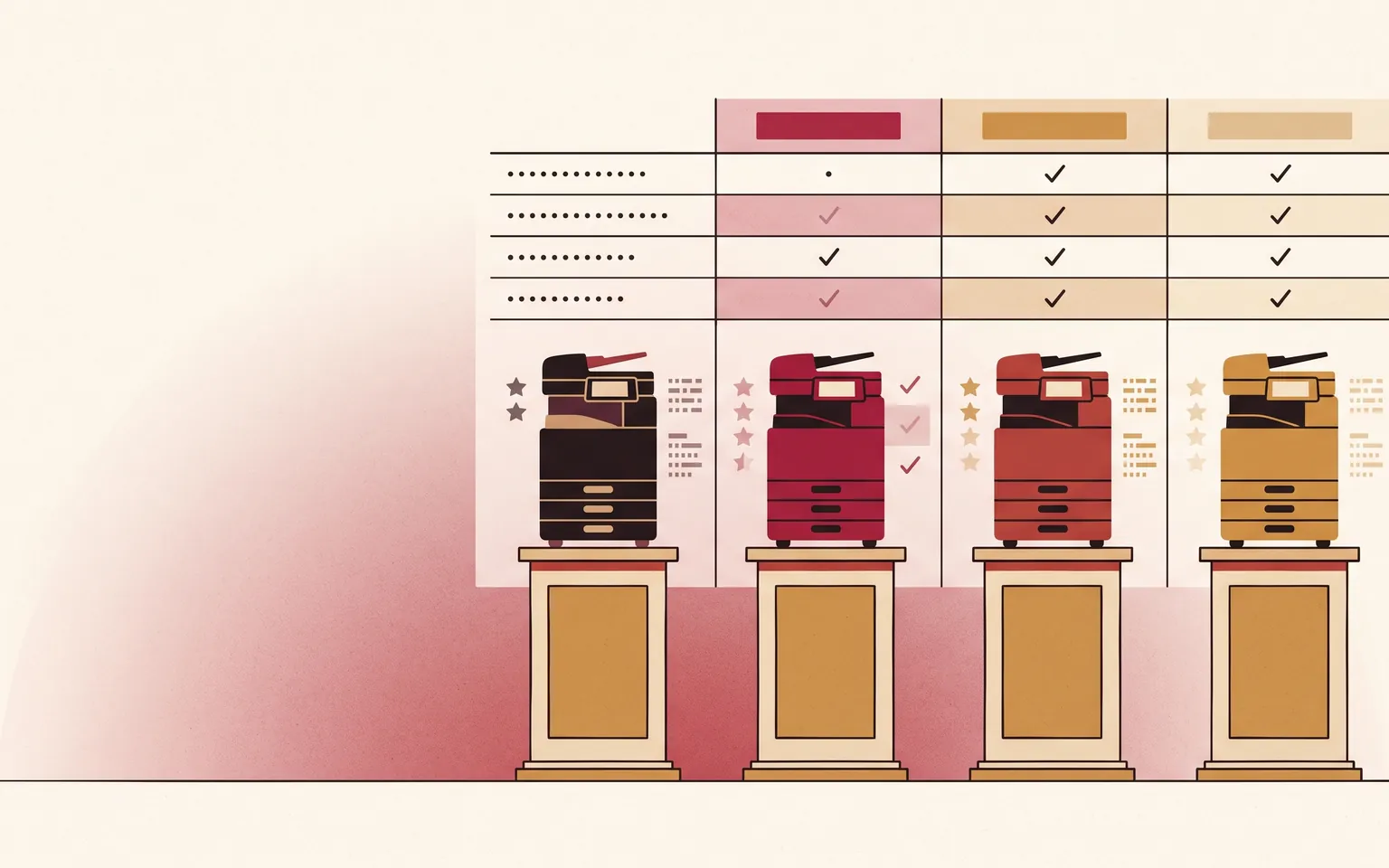
Almost every Pacific procurement process for office printers eventually shortlists some combination of Ricoh, Kyocera, Toshiba and Brother. They are the four brands that have meaningful presence in Pacific markets, mature dealer networks, and product lines spanning the volumes most Pacific organisations actually need.
We supply Ricoh as our primary brand. We have written separately about why we chose Ricoh as our hardware partner — that piece is positioning. This piece is different. It is a balanced comparison of all four brands, written as honestly as we can, including the scenarios where one of the alternatives is the better answer.
The reason to write it this way is straightforward: a comparison that tells procurement teams what they already suspect (every vendor’s own marketing claims their brand is best) is useless. A comparison that names the real trade-offs — including the ones that do not favour us — is the one procurement teams trust enough to use.
How each brand actually positions
Each of the four brands has a different commercial centre of gravity. Understanding which one a vendor is actually built around matters more than reading individual spec sheets.
Ricoh is positioned as a managed-service brand. The hardware is engineered with the expectation that it will be sold on a service contract — toner phones home, fleet-management reporting is built in, secure-print release is native, the device is designed for the technician relationship to be ongoing rather than one-off. Ricoh’s pricing reflects this: outright purchases are not where Ricoh competes hardest, and Ricoh dealers tend to push managed contracts because that is where the engineering investment was made.
Kyocera is positioned as a long-life, low-running-cost brand. The hardware uses a unique drum-and-developer design (the “ceramic drum”) that has longer service intervals than competing engines. Kyocera devices typically have lower cost-per-page on mono A4 work and are mechanically simple to service. The trade-off is fewer features at the top of the line and a sparser dealer network outside major markets.
Toshiba is positioned as a mid-market enterprise brand with strong feature parity to the largest manufacturers. The e-STUDIO multifunction line has a competent feature set, mature security capabilities and broad regional dealer coverage. Toshiba does not differentiate as sharply on any single axis as the others; it tends to win on procurement processes where the buyer wants “competent and safe” rather than “best at X”.
Brother is positioned as a small-business and home-office brand. The product line at the higher-volume A3 multifunction end is real but narrower than the other three. Where Brother dominates is the under-50-users-per-device segment — affordable, reliable, designed for outright purchase with limited ongoing service.
These positionings are real differences, not marketing claims. They drive the engineering priorities, the dealer programmes and the support models behind each brand.
Where Pacific buyers see the real differences
Spec-sheet comparisons of two A3 colour multifunction printers from these four brands will typically look broadly similar. The print speed will be within a few pages per minute, the paper handling will be similar, the security feature lists will name the same controls. The differences that actually matter to a Pacific buyer show up in places spec sheets do not.
Parts inventory in-country. Ricoh and Toshiba have the deepest dealer networks across Pacific markets, and the in-country parts inventories tend to reflect this. Kyocera is variable — strong in some markets, light in others. Brother does not generally operate the same in-country dealer model in the same way; service for Brother devices in smaller Pacific markets tends to route to regional support out of Auckland or Sydney.
Technician availability. The same pattern holds for service technicians. Ricoh and Toshiba’s dealer models support training and certifying local technicians. Kyocera’s dealer presence is meaningful in Fiji and Samoa but thinner in other Pacific markets. Brother’s small-business positioning means the service model is built around courier-return repair rather than on-site technician visits.
Toner stocking commitments. Toner availability in-market matters more than buyers realise until they run out at month-end. Ricoh and Toshiba dealers typically maintain forecast-against-volume toner stocks for the customer base. Kyocera’s lower-cost-per-page positioning sometimes correlates with leaner local stocking, which translates into longer waits when you need cartridges fast. Brother is mainly sold through retail and online channels in Pacific markets; consumables are ordered as needed rather than forecast against an installed base.
Software and integration depth. Ricoh’s fleet-management and scan-routing software ecosystem is the most developed of the four for managed-print operations at scale. Toshiba is competitive. Kyocera’s HyPAS platform is open and capable but typically requires more configuration work. Brother’s software stack reflects its small-business positioning — capable but not comparable to the others at fleet scale.
Sustainability and recycled-content commitments. Ricoh has been notably consistent on published environmental commitments. Toshiba has improved materially in this area in recent years. Kyocera makes the strongest claims about longevity-based sustainability — a longer-life drum means fewer replacements, which is a real environmental argument. Brother’s smaller installed base in commercial fleet contexts means the conversation is less developed.
A buyer’s matrix: which brand fits which scenario
The honest answer to “which brand is right for us” depends on what the organisation actually is and how it actually buys.
A small office (under 10 users, low volume, outright purchase, no service contract): Brother is often the strongest value. The Brother device will cost noticeably less than the equivalent from Ricoh, Toshiba or Kyocera, and the limited ongoing service is a fair trade for the low usage. We will say so if a prospect’s actual scenario is this one.
A mid-sized business focused on lowest possible cost-per-page on mono A4 high-volume work: Kyocera deserves serious consideration. The lower per-page running costs are real, and in cost-sensitive environments printing tens of thousands of mono pages a month, the saving compounds materially. The trade-off is the lighter Pacific-market service depth, which matters more in some Pacific markets than others.
An organisation already standardised on a Toshiba fleet wanting to refresh or expand: the migration cost from one brand to another is often greater than the incremental service benefit. Toshiba is a competent brand with real Pacific dealer presence; staying on it is usually the right call unless there is a specific reason to switch.
An organisation prioritising service quality, parts availability, security-baseline depth, fleet management at scale, or managed-print as the operational model: Ricoh is what we would recommend. This is our supplier choice for the reasons explained in our separate post. It is not because Ricoh is the cheapest sticker price or the best at every individual axis — it is because the operational model behind a Ricoh-on-managed-print contract is the deepest match for the service standard we have committed to.
A specialist production application — long-run perfect-bound books, label converting at industrial scale, very specific finishing requirements: none of the four brands above is necessarily the right answer. Konica Minolta, HP Indigo, Heidelberg and Komori cover specific production niches better than the office-MFP brands. We refer customers to specialist suppliers when this is the situation rather than pushing them onto kit that does not fit.
What this comes back to
The right brand is the brand whose total operational picture fits the buyer’s actual scenario. The sticker price is one input of many. The five-year cost — including parts freight, downtime, service depth, technician availability and the cost of an early replacement if the cheaper unit fails — is the number that matters.
Pacific buyers who do this calculation honestly often land on Ricoh because the service model matches what Pacific markets actually need. Pacific buyers in different scenarios — small office, cost-per-page-led, already-Toshiba-fleeted, specialist production — sometimes land on different brands, and we will tell you so when that is the case.
The vendor who refuses to acknowledge that any competitor is ever the right answer is selling you a sales pitch. The vendor whose honest comparison includes the scenarios where they are not the right answer is the vendor whose recommendation, when they do say “yes, we are the right answer”, is more believable.
If you would like our honest read on which of the four brands fits your specific scenario — including a recommendation against Ricoh if that is the right call for your situation — get in touch. The conversation is free and the answer is not always “buy from us”.