
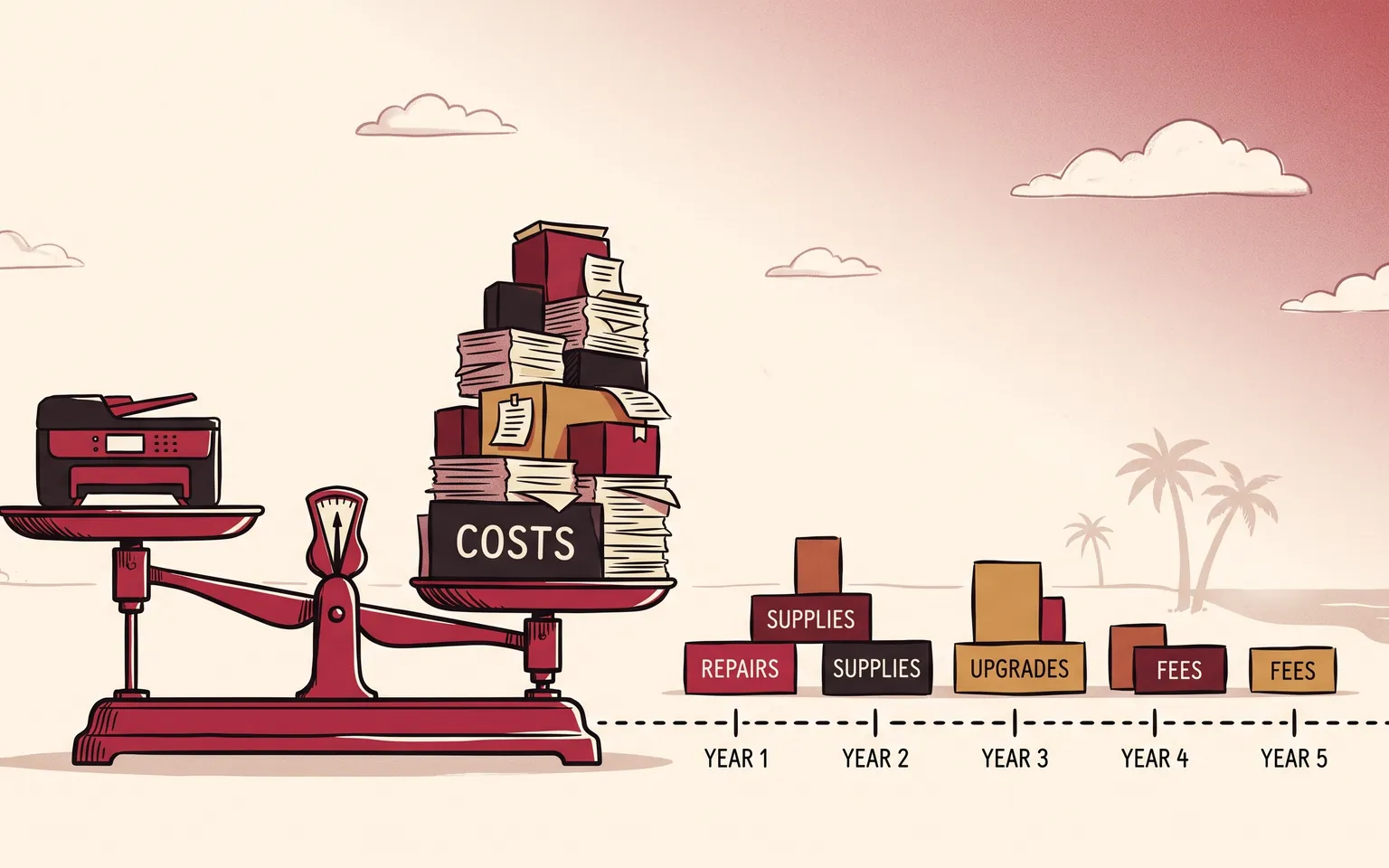
When a procurement team compares printer quotes, the comparison is almost always done on a single number: the sticker price of the device, sometimes paired with a vendor-quoted cost-per-page rate. The supplier with the lowest of these wins.
The problem is that those two numbers describe roughly twenty percent of what the printer actually costs to operate over its working life. The other eighty percent shows up in lines that do not appear on the quote — and in Pacific markets those hidden lines compound harder than they do almost anywhere else.
This piece walks through what total cost of ownership actually includes for a Pacific printer fleet, why the sticker-price comparison routinely chooses the wrong supplier, and what to ask suppliers to bid against if you want a comparison that reflects the cost you will actually pay.
The sticker-price trap
A printer is not a one-time purchase. It is a five-year operational relationship that includes the device, the consumables that feed it, the parts that fail and need replacing, the technicians who fix it, the freight that gets parts and consumables into the country, the downtime when something is broken and not yet fixed, the staff time spent coordinating with the vendor, and the cost of replacing the device early if it fails before its book life is up.
Each of those is a real expense. Each shows up in the operating budget over the device’s life. The quote you compared on price covered the first one — the device itself — and sometimes a slice of the second.
The other lines either get bundled into a different line item on a managed-print contract (so they are predictable) or they appear as one-off surprises over the next sixty months (so they are not). The sticker price comparison does not reveal which of those two futures you are buying.
The twelve cost lines that determine actual TCO
A genuine total-cost-of-ownership calculation for a Pacific printer fleet covers, at minimum, these lines over a five-year window:
- Device acquisition — the sticker price, with or without subsidy. Visible on every quote.
- Toner and ink consumables — proportional to volume, varies materially by yield and by vendor. Sometimes priced into a cost-per-page, sometimes a separate ongoing line.
- Drums and developer — periodic consumables on most colour MFPs, usually quoted as “service kit” replacements at fixed intervals. Often missed in price comparisons.
- Imaging units and other long-life parts — fusers, transfer belts, paper-feed rollers, separation pads. Each has an expected lifespan; each fails eventually; each costs three- to four-figures (NZD) to replace.
- Service labour — preventive and break-fix visits. A managed contract bundles this; an unmanaged purchase pays per call-out.
- Freight on parts and consumables — significant in Pacific markets. A non-stock part that ships from Auckland or Sydney can carry hundreds of dollars in freight on top of the part itself, and add a week to a fix.
- Downtime cost — the staff hours lost while the device is offline, the redirected work, the missed deadlines. Almost never costed explicitly, but almost always significant. A central A3 device down for two days in a thirty-person office costs more than the device’s monthly contract value.
- Toner stock-out cost — emergency air-freight for an out-of-stock cartridge, plus the downtime while it travels. A single stock-out event can wipe out the per-page savings from a year of cheaper consumables.
- Helpdesk and IT time — every paper jam, every driver issue, every “the printer is offline” ticket consumes internal IT time. A consolidated managed contract usually moves these to the provider; an unmanaged fleet leaves them with the customer.
- Software and reporting — fleet management agents, secure-print release, scan routing, security configuration. Included on most managed contracts, charged extra on most outright purchases.
- End-of-life disposal and data sanitisation — the device storage holds spooled jobs. Disposing of a multifunction printer responsibly means certified data wipe, environmental disposal, and the freight that goes with both. Real cost, usually unbudgeted.
- Replacement-before-end-of-life risk — the probability that a cheaper device fails or becomes uneconomic to maintain before its planned five-year life is up. The replacement device, the migration cost, and the productivity gap during the transition all land on the customer.
Many comparisons stop at lines 1 and 2. Honest comparisons cover all twelve.
A worked example: five-year cost over a single A3 colour MFP
Consider a thirty-user office in Apia, Honiara, Port Vila or Nuku’alofa printing around five thousand pages a month, mixed colour and mono. Two procurement options:
Option A — outright purchase of a cheaper A3 colour MFP, consumables bought as needed. Device sticker price is materially lower. Toner and parts are bought from the supplier or grey-market sources when needed. Service is paid per call-out. No managed reporting.
Option B — a managed-print contract on a higher-spec A3 colour MFP, bundled per-page rate, automatic toner, parts and labour included. Higher monthly figure on the contract line; nothing else on the invoice.
Over sixty months, Option A’s visible cost (device plus toner plus paid-call service) is typically twenty to forty percent below Option B’s invoice. Option A’s actual cost, with all twelve lines included, is typically twenty to fifty percent above Option B — driven primarily by lines 6 (freight on parts and consumables), 7 (downtime), 8 (toner stock-outs), 9 (helpdesk burden), and 12 (mid-contract replacement). The Pacific freight environment is what tips the balance hardest; in a market with same-day parts availability and no significant freight overhead, the gap closes.
The cost lines are real either way. The question the procurement team is answering is whether to pay for them through a predictable bundled rate or through unpredictable one-off events.
The lines that catch Pacific buyers most often
In our experience supporting Pacific customers across Samoa, Vanuatu, Tonga, the Solomon Islands and New Zealand, four cost lines surprise organisations that bought on sticker price:
Parts freight to non-Auckland-or-Wellington markets. A fuser unit that costs four hundred dollars in New Zealand can land at over twelve hundred in Apia or Honiara once freight, customs handling and the supplier’s freight markup are included. Multiply by the number of parts that need replacing over five years.
Productivity loss during a wait. When a multifunction printer is offline, the work does not stop — it gets redistributed onto whatever device is still working, slows down whatever queues build behind it, and absorbs whatever staff time is spent finding workarounds. Two days of downtime on a central device often costs more than the device itself.
Toner stock-outs at the worst moment. Consumables in-country at standard freight cost a fraction of consumables flown emergency-overnight to the customer site when the team runs out mid-deadline. Unmanaged fleets hit this once or twice a year per device.
The mid-contract surprise replacement. Cheaper devices have shorter book lives in heavy-use environments. When a sub-spec device gives up at year three rather than year five, the customer carries the cost of replacement, migration, retraining and the productivity gap — none of which appeared in the original procurement quote.
These four lines, summed across a five-year contract, are the difference between Option A and Option B in the worked example above.
What to ask suppliers to bid against
If you want a price comparison that reflects what you will actually pay, the request for quotation needs to ask for more than device sticker price and cost per page. A bid that lets you compare like-for-like includes:
- All-in monthly cost for a five-year contract covering device, toner, drums, service kits, parts, labour and freight
- Defined response-time SLA for break-fix in your specific market, with documented historical performance
- Inventory of parts the supplier holds in country versus parts requiring international freight
- Toner stocking commitments — what is held locally, what is forecast against your volume
- Software inclusions — fleet management agent, secure-print release, scan destinations, reporting
- Mid-contract escape clauses if the supplier’s service standard does not hold
- End-of-life provisions — secure data wipe, environmentally responsible disposal, certificate of destruction
A supplier who can bid concretely against those lines is selling you the actual TCO. A supplier who can only quote the device and a per-page rate is leaving the rest of the cost as your problem.
What to track instead
The right number for procurement to track is not sticker price, and not even cost per page in isolation. It is the all-in monthly cost over a defined five-year window, against documented service commitments, with the freight and downtime exposure named explicitly.
That number is what your finance team will eventually see in the operating budget over the next sixty months. The earlier in the procurement cycle it shows up, the cheaper the printer fleet you end up with — even when the device on the contract is the more expensive one.
If you are evaluating a printer contract today and would like a five-year TCO model built against your actual volume and market, get in touch. We can produce a worked TCO comparison against any competing quote you are considering, including freight and downtime assumptions specific to your market, before you sign anything.